


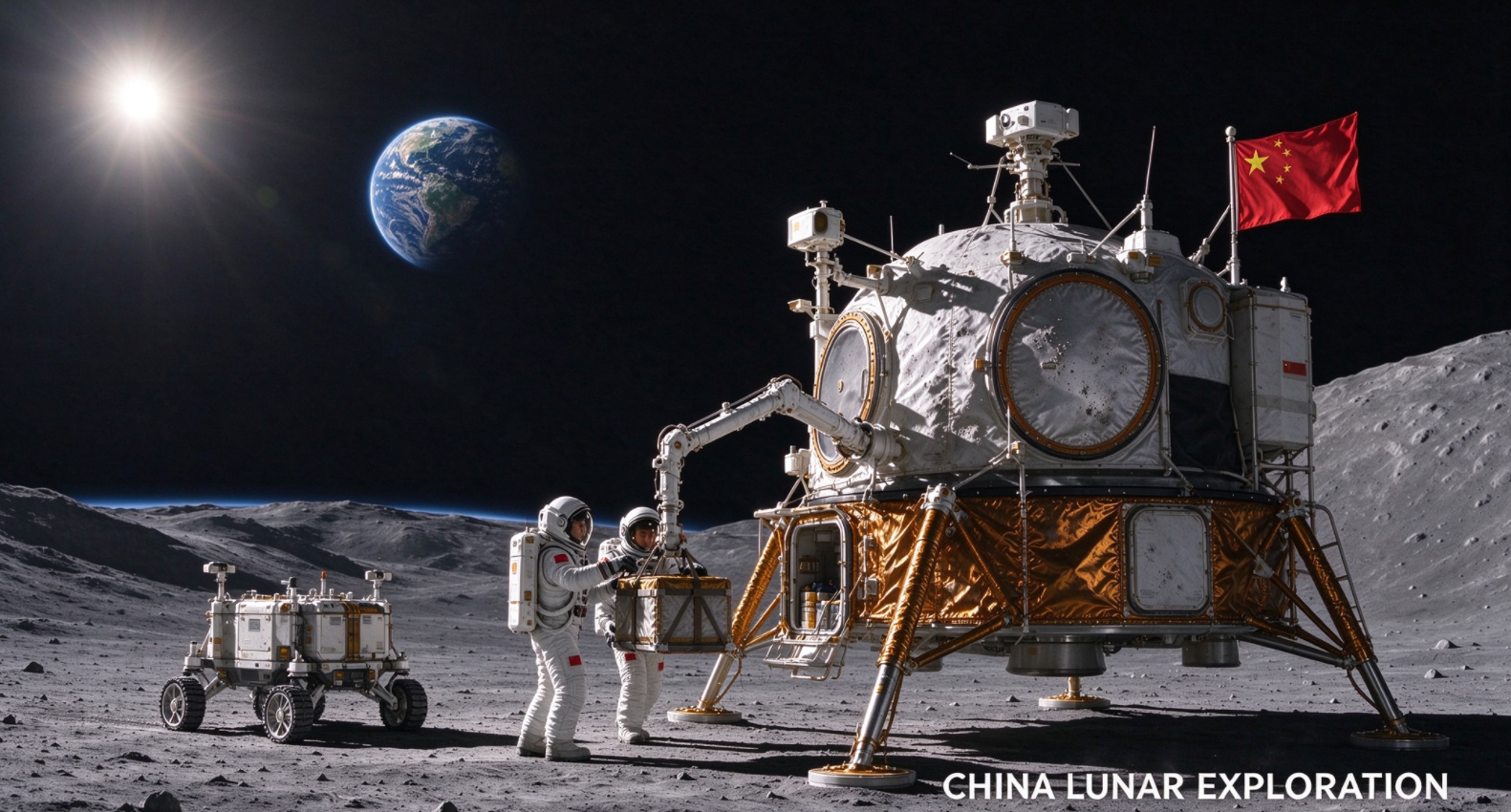
At the 7th Manned Space Symposium here, top Chinese space official Wang Xiang laid out the full flight blueprint for China’s crewed lunar landing mission, laying bare a sophisticated two-launch architecture that marks Beijing’s clearest public explanation yet of its race to send astronauts to the moon.
Wang, deputy chief designer of China’s Manned Space Program and chief designer of its manned lunar exploration project, outlined a plan built around two new spacecraft: the Mengzhou crew capsule and the Lanyue lunar lander. Unlike NASA’s historic Apollo missions, which sent a single stacked spacecraft toward the moon atop one giant rocket, China intends to split the hardware into two separate launches using its new Long March 10 heavy-lift rockets.
One Long March 10 will blast off carrying the Lanyue lander. A second rocket will lift the Mengzhou spaceship with astronauts aboard. The two vehicles will travel independently across nearly 380,000 kilometers to lunar orbit, where they must rendezvous and dock in the vacuum of space. Once linked up, astronauts will transfer from Mengzhou over to Lanyue. Mengzhou will remain circling the moon while the lander carries the crew down to the lunar surface for scientific work.
When their surface mission wraps up, the astronauts will lift off again aboard the lander, rejoin the waiting Mengzhou craft in lunar orbit, climb back into the crew ship, and begin the long trip home to Earth.
The approach is a deliberate engineering choice tailored to China’s existing industrial and launch infrastructure, Wang explained. Breaking the mission into two launches allows developers to build reusable, modular vehicles that can support later projects, including the planned International Lunar Research Station. It is not just a one-off stunt, but the start of a sustained long-term lunar program.
That does not mean the path ahead is simple. Coordinating two separate launch windows precisely enough to meet in lunar orbit presents major technical hurdles. Deep-space rendezvous and docking far from Earth is among the hardest challenges in human spaceflight. Still, Wang struck a confident tone, noting China’s ability to marshal national resources to tackle tough engineering barriers.
Ground and flight testing is already well underway. The Mengzhou capsule has passed critical abort tests designed to save astronauts if something goes wrong during launch. The Lanyue lander has completed integrated descent and ascent trials to prove it can touch down and blast off from the moon. The Long March 10 rocket has finished low-altitude demonstration tests.
China has built steadily toward this moment over decades. Its Chang’e robotic missions have orbited, landed on, and brought samples back from the moon, including the world’s first sample return from the lunar far side. The Tiangong space station, now operating routinely, has given Chinese astronauts extensive experience with long-duration orbital flight and spacewalks. All of that know‑how forms the foundation for the crewed landing target: before 2030.
As nations around the world ramp up lunar ambitions, the moon has become a central frontier for deep-space exploration. China says its strategy will proceed step by step, with an eye toward lunar resource research and international cooperation on the future moon base. If all goes to plan, the docking of Mengzhou and Lanyue above the moon will stand as a landmark moment for Beijing’s rapidly expanding space program.
